Introduction
This 7 day meal plan to lose weight runs on the plate method, with a grocery list, two short prep sessions, and a way to fit your calorie level.
What a 7 day meal plan to lose weight actually is
A 7 day meal plan to lose weight is a week of meals you decide once, shop for once, and then stop thinking about. That last part is the point. Most diets fail on the daily decisions, not on the food. You get home late, the fridge has nothing ready, and the plan collapses at 7 pm on a Tuesday. A week that is already written removes that moment.
This plan is not a crash week. The CDC notes that people who lose weight at a gradual, steady pace of about 1 to 2 pounds a week are more likely to keep it off than people who lose it faster. So the goal of the seven days below is not a dramatic number on Sunday. The goal is a week you can run again on Monday, and again the week after, because it fits a normal life with a job and a family.
The plan is built on three fixed targets and one plate rule. You set the targets once. The plate rule makes every meal fit without a food scale. Then the week itself is a menu you can follow as written or swap piece by piece. If you want the deeper reasoning behind the targets, the weight loss meal plan guide covers it. This post is the week itself.
Set your targets once: calories, protein, fiber
You need three numbers before you cook anything. Get them once and write them on the fridge.
The first is a daily calorie range. Weight loss needs a calorie deficit, and the calorie deficit diet plan for weight loss post explains how to find yours from your maintenance level. If you want a starting point, the TDEE calculator estimates your maintenance calories, and a moderate deficit under that number is where the sample week below sits. Our ready-made meal plans are built at fixed levels, from 1,200 to 1,700 calories a day, so you can also pick a plan whose level matches you and skip the arithmetic.
The second is a daily protein target. A review in the American Journal of Clinical Nutrition found that higher-protein diets improve appetite control and body weight management. The range it describes is 1.2 to 1.6 grams per kilogram of body weight per day, with roughly 25 to 30 grams of protein per meal. For a 180 pound adult that works out to about 100 to 130 grams a day, which is four meals with a real protein source each. The protein calculator gives you the number for your own weight.
The third is fiber. MedlinePlus reports that adults should eat 21 to 38 grams of fiber a day, and that the average American eats about 16. Fiber is what makes a smaller plate feel like enough. The week below leans on beans, oats, berries, and vegetables to close that gap, and the foods that have high fiber post ranks the best sources if you want to swap.
The NIDDK describes the shape of a healthy eating plan as vegetables of all types, whole fruit over juice, whole grains, low-fat dairy, lean protein, seafood, beans and lentils, nuts and seeds, and oils like olive oil. It also sets limits worth writing next to your targets: added sugars under 10 percent of calories, saturated fat under 10 percent, and sodium under 2,300 milligrams a day. Every meal below was chosen to fit inside that frame.
The plate rule that makes every meal fit
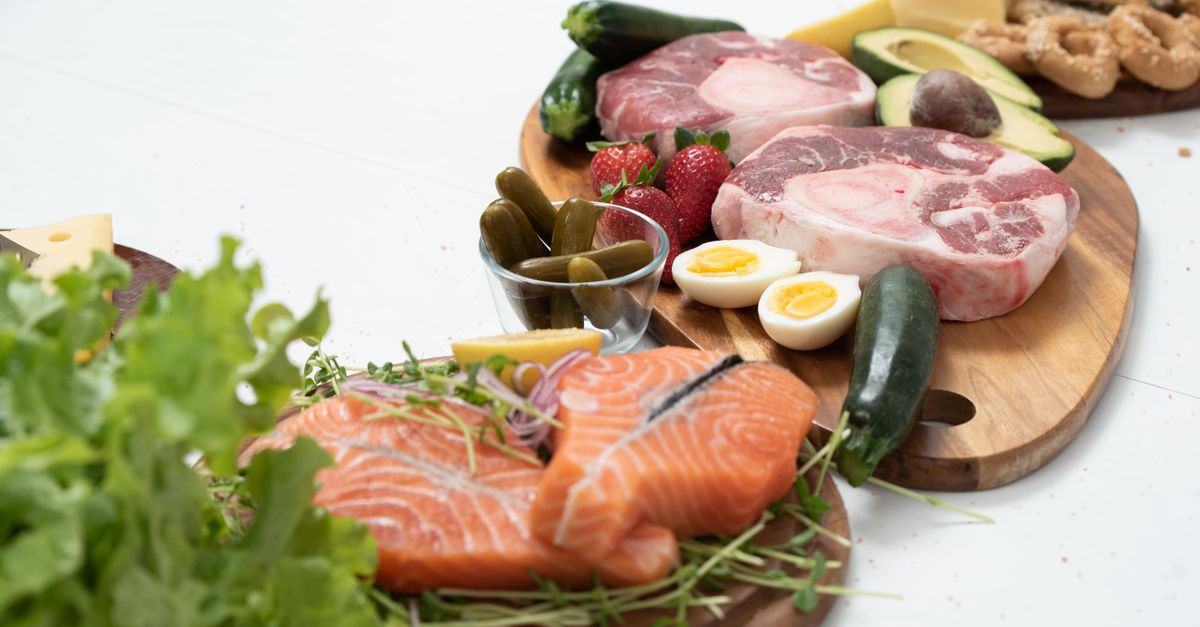
You do not need to weigh food to run this week. You need one rule that you apply to every plate. MedlinePlus describes it plainly: half of your plate is non-starchy vegetables, and the other half is split between lean protein and whole grains.
That rule does three jobs at once. The vegetable half keeps calories low and fiber high. The protein quarter delivers the 25 to 30 grams each meal needs. The grain quarter gives you enough carbohydrate to train and to sleep without a portion large enough to stall the week.
The plate rule also tells you how to fix a meal that went wrong. Too hungry an hour later? The protein quarter was too small or the vegetable half was missing. Sluggish after lunch? The grain quarter grew into a half. You adjust the ratio, not the whole plan.
The 7 day meal plan
Here is the week. Breakfasts repeat in pairs on purpose, because a breakfast you make on autopilot is one you will actually eat. Lunches are mostly leftovers from the night before, which is the whole reason for the prep sessions in the next section. Snacks are optional and small, so drop them first if you need to move to a lower calorie level.
| Day | Breakfast | Lunch | Dinner | Snack |
|---|---|---|---|---|
| Monday | Overnight oats with Greek yogurt, blueberries, and chia seeds | Grilled chicken bowl with brown rice, roasted broccoli, and salsa | Baked salmon, roasted sweet potato, and a large green salad with olive oil and lemon | Apple with a tablespoon of peanut butter |
| Tuesday | Two scrambled eggs, one slice whole grain toast, and sauteed spinach | Leftover salmon flaked over mixed greens, cherry tomatoes, and cucumber | Turkey chili with black beans, peppers, and onion, topped with plain Greek yogurt | Cottage cheese with sliced peach |
| Wednesday | Overnight oats with Greek yogurt, strawberries, and ground flaxseed | Leftover turkey chili with a side of raw carrots | Sheet pan chicken thighs with Brussels sprouts and quinoa | Handful of almonds |
| Thursday | Two scrambled eggs, one slice whole grain toast, and sliced tomato | Leftover chicken and quinoa with a handful of arugula and balsamic | Shrimp stir-fry with snap peas, bell pepper, and cauliflower rice | Plain Greek yogurt with cinnamon |
| Friday | Greek yogurt parfait with raspberries and two tablespoons of oats | Lentil soup with a side salad | Lean beef and vegetable skewers with a small baked potato and green beans | Pear and a string cheese |
| Saturday | Vegetable omelet with mushrooms, onion, and a little feta, plus half an orange | Leftover lentil soup with a slice of whole grain bread | Baked cod with roasted zucchini, tomatoes, and farro | Air-popped popcorn, three cups |
| Sunday | Greek yogurt parfait with blueberries and walnuts | Big chopped salad with chickpeas, leftover beef, and tahini dressing | Slow cooker chicken and white bean stew with kale | Dark chocolate square and a handful of berries |
Every dinner is a plate-rule plate. Every lunch that says leftover is the previous dinner, portioned into a container while you clean up. The high protein meals to lose weight post has more dinners in this same shape if you want to rotate a few in next week.
If you would rather follow a week with the calories and macros already counted for each meal, our 1500 calorie high protein meal plan and 1200 calorie meal plan are the same idea with the arithmetic done. For a different flavor profile, the 7 day high protein meal plan and the mediterranean diet meal plan for weight loss follow the same plate rule.
Grocery list for the week
Shop once. The list below covers every meal in the table for one person. Quantities are approximate, and you should scale them if you are cooking for two, which is the easiest way to keep the plan going when a partner eats with you.
| Category | Items |
|---|---|
| Protein | Chicken breast (1.5 lb), chicken thighs (1 lb), salmon fillets (2), cod fillets (2), shrimp (1 lb), lean ground turkey (1 lb), lean beef sirloin (1 lb), eggs (1 dozen), plain Greek yogurt (2 large tubs), cottage cheese (1 tub), feta (small block), string cheese |
| Beans and grains | Black beans (2 cans), white beans (1 can), chickpeas (1 can), dried red lentils (1 bag), rolled oats, brown rice, quinoa, farro, whole grain bread, popcorn kernels |
| Vegetables | Broccoli, Brussels sprouts, spinach, kale, mixed greens, arugula, sweet potatoes, one russet potato, zucchini, bell peppers, snap peas, cauliflower rice, green beans, mushrooms, onions, carrots, cherry tomatoes, cucumber, garlic |
| Fruit | Blueberries, strawberries, raspberries, apples, pears, one peach, one orange, lemons |
| Pantry | Olive oil, balsamic vinegar, tahini, peanut butter, almonds, walnuts, chia seeds, ground flaxseed, salsa, low-sodium chicken broth, canned crushed tomatoes, chili powder, cumin, cinnamon, dark chocolate |
Two notes on the list. Buy frozen vegetables and frozen berries where you can. They cost less, they do not spoil by Thursday, and the nutrition is the same. And check the sodium on canned beans and broth, since the NIDDK limit of 2,300 milligrams a day is easy to blow through with two cans of the salted kind. Rinsing canned beans helps.
If the list looks expensive, the cheap high protein meal plan shows how to run the same week on eggs, canned fish, beans, and frozen vegetables. If you do not eat meat, the high protein vegetarian meal plan swaps every animal protein above for lentils, tofu, tempeh, and dairy.
Two prep sessions, forty minutes each
The plan works because you never cook from zero on a weeknight. Two short sessions do most of the work.
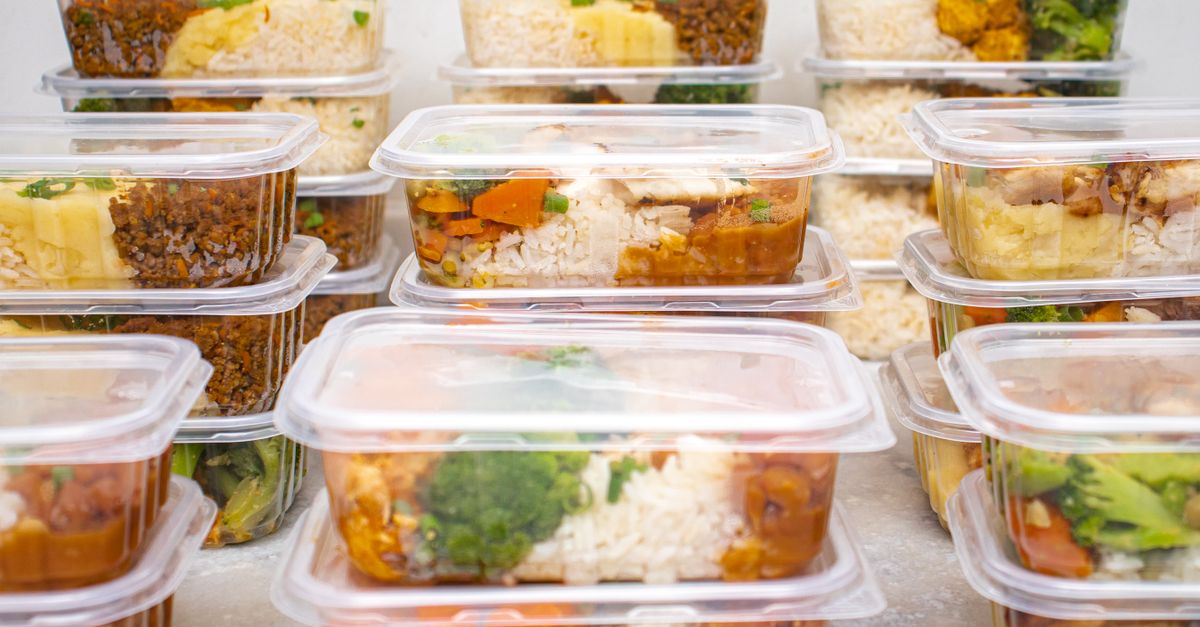
Sunday, forty minutes. Cook a pot of brown rice and a pot of quinoa. Roast two sheet pans of vegetables: broccoli and sweet potato on one, Brussels sprouts and zucchini on the other. Hard boil four eggs for emergencies. Make two jars of overnight oats. Portion Greek yogurt and berries into containers for the parfait days. Wash and chop the salad vegetables so a bowl takes two minutes to build.
Wednesday, forty minutes. Make the lentil soup, which is Friday lunch and Saturday lunch. Marinate the beef for Friday. Prep the stir-fry vegetables for Thursday. Restock chopped salad vegetables if they ran out.
Everything else is a one-pan dinner cooked fresh, with the previous dinner portioned as tomorrow's lunch while the pan cools. That is the whole system. No recipe on this plan takes more than 30 minutes of active time.
How to adjust the plan for your calorie level
The week as written lands in the middle of the range our meal plans use. Most people will not need to count, because the plate rule already holds each meal in a sensible band. But if you know your number from the calculator, here is how to move the week up or down without rewriting it.
To go lower, drop the snacks first. Then shrink the grain quarter of the plate at dinner to a half portion, and let the vegetable half grow to fill the space. Do not cut the protein quarter. Losing protein is the fastest way to lose muscle instead of fat, and it also makes the next meal harder to wait for.
To go higher, add a second snack, increase the grain portion at lunch, and add a tablespoon of olive oil, nuts, or avocado to dinner. Active people and larger bodies need more than the week gives as written, and running a deficit that is too deep tends to end in a weekend that undoes the week.
A position stand from the International Society of Sports Nutrition reviewed the major diet types. It concluded that when calories and protein are matched, the different approaches produce similar body composition results. The best diet is the one a person can stick to. That is the reason this plan does not ask you to cut out carbohydrates, or fat, or a whole food group. It asks you to hold the plate rule and hit three numbers.
What to do when the week is over
Run it again. That sounds too simple, but it is the honest answer. The second week is easier than the first because the shopping list is known, the prep sessions are rehearsed, and you have already discovered which two dinners you did not like. Swap those two and keep the rest.
By the third week most people rotate. Keep the structure, change the proteins and the vegetables, and pull a new dinner or two from a different meal plan. The plate rule and the three targets are what carry over. The specific meals are just this week's version of them.
Watch the trend on the scale, not any single day. Water, salt, and the time of your last meal move the number by a pound or two on their own. If the weekly average moves down by something in the CDC's 1 to 2 pound range, the plan is working, and there is nothing to change. Our rule of thumb is three weeks. If it does not move for three weeks running, revisit the calorie number, because maintenance may have dropped as your weight did.
If you have a health condition, take medication that affects appetite or blood sugar, or are pregnant, ask your prescriber before starting a calorie deficit. This plan is a general template, not personal medical advice.
Frequently asked questions
How much weight can you realistically lose in 7 days?
Realistically, a pound or two of fat, plus some water weight in the first week that will not repeat. The CDC describes a safe, sustainable pace as about 1 to 2 pounds a week, and notes that people who lose at that rate are more likely to keep the weight off. A larger drop on the scale in week one is mostly water, not fat, and it does not repeat in week two. Judge the plan by the three-week trend, not by what one Sunday morning says.
What can I eat to lose weight in 7 days?
To lose weight in 7 days, eat meals built on the plate rule: half non-starchy vegetables, a quarter lean protein, and a quarter whole grains, with a small amount of fat from olive oil, nuts, or avocado. In practice that means eggs, Greek yogurt, chicken, fish, beans, lentils, oats, brown rice, quinoa, and a wide range of vegetables and whole fruit. The week in this post is one example. What matters more than any single food is that each meal has a real protein source and enough vegetables and fiber to keep you full until the next one.
Do I need to count calories on this plan?
Not at the start. The plate rule keeps most meals inside a sensible calorie band without weighing anything, and the two prep sessions make the portions repeat from day to day. Our rule of thumb is three weeks without movement on the scale. That is the point to get a real number from the TDEE calculator and compare it to a day of your actual portions. If you want the arithmetic done for you from the first day, the ready-made meal plans on this site list calories and protein for every meal.
Can I repeat the same 7 day meal plan every week?
Yes, and for the first few weeks that is the best move. Repeating the week removes the daily decisions that break most diets and makes the grocery run and the prep sessions faster each time. Nutritionally the week already covers vegetables of all types, whole grains, lean protein, seafood, beans, dairy, and healthy oils, which is the mix the NIDDK describes. After two or three rounds, rotate a couple of dinners and proteins so the plan stays interesting and your vegetable variety stays wide.
Is it safe to lose 20 pounds in 7 weeks?
For most people, no, not as a plan. That pace is nearly 3 pounds a week, which sits above the 1 to 2 pounds a week the CDC describes as gradual and steady. Some people with a large amount of weight to lose do see faster early losses, but a plan aimed at that number for seven straight weeks usually means a deficit deep enough to cost muscle and to be hard to hold. A better target is the CDC range with a plan you can repeat. If you have a deadline or a medical reason to move faster, ask your prescriber rather than cutting further on your own.