Introduction
The best leg exercises for quads, hamstrings, glutes, and calves, with form videos, a simple sets and reps plan, and how to progress.
Why leg day is worth the effort
The best leg exercises train the largest muscles you own. Your quads, hamstrings, glutes, and calves move you through every step, stair, and squat of the day, and together they make up well over half of your body's muscle mass. Training them hard does more than build size. It raises the calories you burn at rest, protects your knees and hips as you age, and carries over to almost everything else you do, from sprinting to standing up from a chair without using your hands.
Legs also reward you for the simple reason that they respond to load. A muscle group this big can handle heavy compound lifts like the squat and the deadlift, and those lifts drive a strong, full-body hormonal and strength response that smaller isolation moves cannot match. If you are managing your weight, lower-body training is one of the best returns on your time in the gym, because it builds and protects the muscle that keeps your metabolism working for you.
The lower body is really four jobs in one. The quadriceps on the front of your thigh straighten the knee and dominate squats and presses. The hamstrings on the back bend the knee and extend the hip, and they drive hinges like the deadlift. The glutes power hip extension behind every squat, lunge, and bridge. The calves finish the chain at the ankle. A complete leg day covers all four, and the routine below does exactly that. The Centers for Disease Control and Prevention recommends muscle-strengthening work across all major muscle groups on at least two days a week, and a focused leg session covers the biggest of those groups in one go. You can read the plain-language version in the CDC adult activity guidelines.
The best leg exercises, in one workout
Run these as a single session. Lead with the heavy compound lifts while you are fresh, then move to the machine and isolation work that finishes each muscle. Every exercise links to a short form video so you can see the movement before you load it.
| Order | Exercise | Sets | Reps | Rest |
|---|---|---|---|---|
| 1 | Barbell squat | 4 | 6-8 | 2-3 min |
| 2 | Romanian deadlift | 3 | 8-10 | 2 min |
| 3 | Leg press | 3 | 10-12 | 90 sec |
| 4 | Dumbbell lunges | 3 | 10-12 | 90 sec |
| 5 | Lying leg curls | 3 | 12-15 | 60 sec |
| 6 | Leg extensions | 3 | 12-15 | 60 sec |
| 7 | Standing calf raises | 4 | 12-20 | 45 sec |
The order moves from heaviest to lightest, and from compound to isolation. The squat comes first because it asks the most of you and builds the most muscle, so it deserves your freshest effort. The Romanian deadlift follows to load the hamstrings and glutes through a long stretch. The leg press and lunges add quad and single-leg volume once the barbell work is done. Leg curls, leg extensions, and calf raises then finish each muscle with focused, lighter sets. If your time is short, run the first four moves and you still cover quads, hamstrings, and glutes.
A short warm-up
Heavy squats and deadlifts load the knees, hips, and lower back, so spend five to ten minutes preparing before any working set. Five minutes on a bike raises your core temperature, then do a round of bodyweight squats, walking lunges, and leg swings. Finish with one or two light sets of the barbell squat at roughly half your working weight to groove the pattern. Warming up the joints and rehearsing the lift lowers your injury risk and makes your heavy sets feel noticeably stronger.
How to do each move with good form
Form is what turns these into the best leg exercises rather than a sore-knee, sore-back mess. Watch the clip for each move, then read the cue.
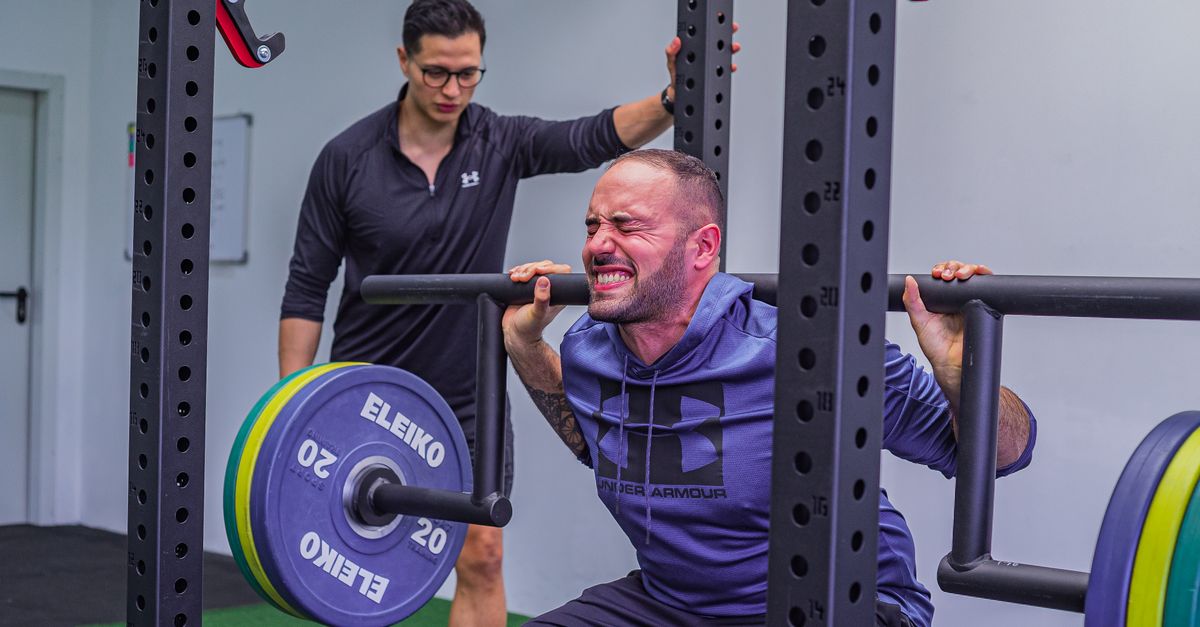
For the barbell squat, set the bar across your upper back, brace your core, and sit down between your hips while keeping your chest tall and your knees tracking over your toes. Aim to break parallel if your mobility allows, then drive up through your whole foot. The leg press lets you push heavy with less demand on your lower back, so it is a useful way to add quad volume after squats. Keep your lower back flat against the pad and avoid letting your knees cave inward at the bottom.
The Romanian deadlift is a hip hinge, not a squat. Keep a soft bend in your knees, push your hips back, and lower the bar along your legs until you feel a stretch in your hamstrings, then drive your hips forward to stand. Your hamstrings are very susceptible to strain when they are stretched under load, which is exactly why control matters more than weight here. The Cleveland Clinic explains the anatomy and why the hamstring muscles tear so easily during fast or heavy movement. The lying leg curls then isolate the same muscles by bending the knee, and a good morning is a useful hinge variation when you want more posterior-chain work.
The dumbbell lunges train each leg on its own, which evens out side-to-side imbalances that a barbell can hide. Step out, drop your back knee toward the floor, and push back up through your front heel. The leg extensions finish the quads with a focused squeeze at the top, and the standing calf raises train the calves through a full range by pausing at the bottom stretch and the top contraction. If you want to swap a move or add variety, the full leg exercises library gives you a video and form guide for every option, and you can browse the whole exercise library by muscle group. Johns Hopkins Medicine has a clear primer on how strength training works and why technique drives the result.
Sets, reps, and how to progress
The plan trains the big compounds in the 6 to 10 rep range and finishes the machine and isolation work in the 10 to 15 range. That spread builds both the strength that drives a heavier squat and the muscular detail that leg curls and extensions bring out. Mayo Clinic notes that even a single set taken close to fatigue can build strength for most people, so three or four focused sets per move give a strong stimulus without endless volume. Their strength training guidance is a solid reference for the basics.
Progress with what lifters call progressive overload, which means doing a little more over time. When you can finish the top of the rep range with clean form on every set, pick one change for next session: add a small amount of weight, add one rep per set, or trim your rest by ten to fifteen seconds. Change one variable at a time so you can see what is actually moving the needle.
Keep a short log of your sessions. Two lines, the weights you lifted and how the last set felt, turns guesswork into a plan. Recovery counts as much as the lifting, so give your legs at least a day, ideally two, before you train them hard again. The National Institutes of Health resource on strength training is a useful reminder that muscle is built in recovery, when you rest and eat, not only during the session.
Mistakes that stall leg growth
The most common mistake is cutting the squat short. A quarter squat lets you load more weight and feels impressive, but it trains a fraction of the muscle. Lower until your thighs are at least parallel to the floor, within what your mobility allows, and the same weight will build far more than a shallow rep ever could. If depth is hard, work on ankle and hip mobility and drop the load until you can hit it.
The second mistake is turning the Romanian deadlift into a squat. If your knees bend a lot and the bar drifts away from your legs, your quads and lower back take over and the hamstrings barely work. Keep the knees mostly fixed, push the hips back, and slide the bar close to your legs. The third is skipping single-leg and calf work entirely. Lunges expose and fix the imbalance between your stronger and weaker side, and calves need direct, higher-rep work because the big barbell lifts do not train them much. Build all four muscles, not just the ones you can see in the mirror.
How to program legs into your week
A leg day fits almost any split. On a three-day full-body week, you can run a squat or a hinge on each day and rotate the accessory work. On a four-day upper-lower split, legs get two dedicated days, one led by a squat and one led by a deadlift, so you train the quads and the posterior chain with roughly equal attention. Once or twice a week is plenty for most people, with at least 48 hours between hard leg sessions so the muscles and joints recover.
Legs and back share the deadlift family and a lot of posterior-chain work, so they pair well across a training week. If you want to round out your pulling and posterior strength, follow the routine in our best dumbbell back exercises guide and browse the back exercises library for video form guides. Consistency beats intensity. Two steady leg sessions a week that you actually finish will build more than a five-day plan you quit by week two.
Quads, hamstrings, glutes, or calves: where to focus
If every part of your lower body needs work, train them in roughly equal measure and lead with your weakest. For the quads, the squat, front barbell squat, and leg press do the heavy lifting, and these are the best quad exercises for most people because they load the muscle hard through a long range. The hamstrings respond to both hinges and curls, so the best hamstring exercises pair a Romanian deadlift with a seated leg curl to cover the muscle's two jobs of bending the knee and extending the hip.
For the glutes, the best glute exercises are heavy hip extension moves like the barbell hip thrust and squats taken to full depth, with a single-leg glute bridge to balance the sides. Calves are the most neglected of the four, so the best calf exercises are simply the standing calf raises and seated calf raise trained for higher reps and a long pause at the stretch. You cannot fully isolate any single muscle, but you can shift the emphasis by changing which lift you lead with and how much volume each one gets. Rotate the focus every few weeks so no part of your lower body gets left behind.
Fueling leg growth
Training is the signal and food is the raw material. Building or keeping muscle while you manage your weight asks for enough protein and a sensible overall intake, so nutrition belongs in any honest leg workout. Aim for a protein source at each meal, plenty of vegetables and fiber, and a calorie level that matches your goal. Leg day in particular leaves you hungry, because it works so much muscle, so plan your meals around it rather than improvising afterward. If you would rather have the planning done for you, our meal plans lay out ready-made days built around real recipes and macros that pair well with a strength routine like this one.
Frequently asked questions
What are the best leg exercises for building muscle?
The barbell squat and the Romanian deadlift build the most lower-body muscle, because they load the largest muscles through a long range of motion and let you add weight over time. The squat drives the quads and glutes, while the Romanian deadlift trains the hamstrings and glutes through a deep stretch. Add a leg press or lunge for extra quad and single-leg volume, then finish with leg curls, leg extensions, and calf raises to target each muscle directly. For most people, two or three compound lifts plus two or three isolation moves per session is the sweet spot. The key is progressive overload: keep adding a little weight or a few reps over the weeks, and the muscle follows.
Can I train legs at home without a barbell?
Yes. Bodyweight squats, walking lunges, step-ups, single-leg glute bridges, and calf raises train every lower-body muscle, and a pair of dumbbells or a set of bands adds resistance once bodyweight gets easy. The muscle does not know whether the load comes from a barbell, a dumbbell, or your own bodyweight on one leg, only that it has to work against resistance that gradually increases. Slow the tempo, pause at the hardest point, and push your sets close to fatigue, and home leg training builds real strength. As you progress, single-leg moves like split squats and pistol-style squats keep the challenge high without heavy equipment.
How often should I train legs?
Once or twice a week works for most people. The CDC recommends muscle-strengthening work covering all major muscle groups on at least two days a week, and a leg session can be one or both of those days. If you train legs twice, lead one day with a squat and the other with a deadlift so you balance the quads and the posterior chain, and leave at least 48 hours between the hard sessions so the muscles and joints recover. Beginners often progress fastest on just two sessions a week before adding more, since the legs respond well to consistent, gradually heavier work.
Should I squat or deadlift first on leg day?
Lead with whichever lift matters most for your goal that day, and do it while you are fresh. If your session is built around quad and overall leg strength, squat first, because the squat is the most demanding movement and deserves your best effort. If you are prioritizing hamstrings and glutes, you can lead with the deadlift instead. What you should not do is run both maximal lifts back to back when you are already fatigued, since that raises your injury risk and cuts the weight you can handle. Pick one to anchor the session, then use the other or a lighter variation as your second movement.