
Introduction
Rapid weight loss on GLP-1 medication burns fat — but it can also cost you muscle. Here's the evidence-based resistance-training plan that protects your lean mass while the medication does its job.
If you are losing weight on a GLP-1 medication, you have probably been thrilled by the number on the scale. But the scale doesn't tell you what kind of weight you are losing. And that distinction matters more than almost anything else for how you look, feel, and keep the weight off long term.
When you lose weight quickly, some of that loss comes from fat and some comes from lean tissue — muscle. A 2024 review in Diabetes, Obesity and Metabolism examined lean body mass changes across GLP-1-based therapies and found that a meaningful share of total weight lost on these medications can come from lean mass, especially when no resistance training is part of the routine. The good news in that same review: the loss is largely preventable. Resistance training and adequate protein are the two levers that keep your muscle on your body while the medication strips the fat off.
This guide is the hub for everything we publish on training while on weight-loss medication. It will not tell you how to dose your medication — that is a conversation for your prescriber. It will tell you exactly how to move your body so that the weight you lose is the weight you actually want to lose.
Why muscle loss is the hidden risk of fast weight loss
Muscle is metabolically expensive tissue. Your body keeps it because you use it — and it sheds it readily when two things happen at once: you are in a calorie deficit, and you are not giving the muscle a reason to stay.
A GLP-1 medication creates a powerful calorie deficit by reducing appetite. That is the whole point. But a deficit alone is a signal to the body that energy is scarce, and muscle is one of the first things the body is willing to give up if it isn't being challenged.
Losing muscle creates a cascade of problems:
- Your metabolism slows. Muscle burns calories around the clock. Less muscle means a lower resting metabolic rate, which makes the last stretch of weight loss harder and makes regain easier once you reach your goal.
- You get weaker and more easily fatigued. Everyday tasks — stairs, groceries, getting up off the floor — get harder, not easier.
- Your body composition can look "skinny-soft" rather than lean. Two people at the same weight can look completely different depending on how much muscle they kept.
The single most effective countermeasure is resistance training. A randomized trial published in 2017 found that combining resistance training with a reduced-calorie diet decreased body fat while preserving lean mass — even independent of changes in resting metabolic rate. In plain terms: lifting tells your body that the muscle is still needed, so it holds onto it.
The three rules of muscle preservation
Everything in this guide reduces to three rules. Get these right and the specific exercises become details.
Rule 1: Train each major muscle group at least twice a week
The CDC's physical activity guidelines for adults recommend muscle-strengthening activities that work all the major muscle groups on at least two days per week. That is the floor, not the ceiling — but for someone losing weight on medication, hitting that floor consistently is what protects your lean mass.
You do not need to train every day. Two to three full-body sessions per week, with a rest day in between, is enough to send the "keep the muscle" signal.
Rule 2: Prioritize protein
Resistance training builds the demand; protein supplies the raw material. A 2016 randomized trial in the American Journal of Clinical Nutrition found that higher dietary protein during a calorie deficit, combined with intense exercise, produced greater lean mass retention and greater fat loss than lower protein. The challenge on a GLP-1 medication is that your appetite is suppressed, so you have to be deliberate about getting protein in. Our guide to high-protein meals for weight loss covers how to do that even when you are not very hungry.
Rule 3: Use compound movements
A compound movement works multiple joints and muscle groups at once — a squat, a row, a press, a hinge. These give you the most muscle-preserving stimulus per minute, which matters when low energy and a suppressed appetite mean your sessions need to be efficient. Isolation moves (like a biceps curl) have their place, but the backbone of your routine should be big, multi-muscle lifts.
The core muscle-preservation movement patterns
You can build a complete muscle-preserving routine from five movement patterns. For each, here are reliable, beginner-friendly exercises drawn from the open-source wger exercise library — chosen because they need little or no equipment, which suits training at home while your energy and appetite are fluctuating.
1. Squat (legs, glutes)
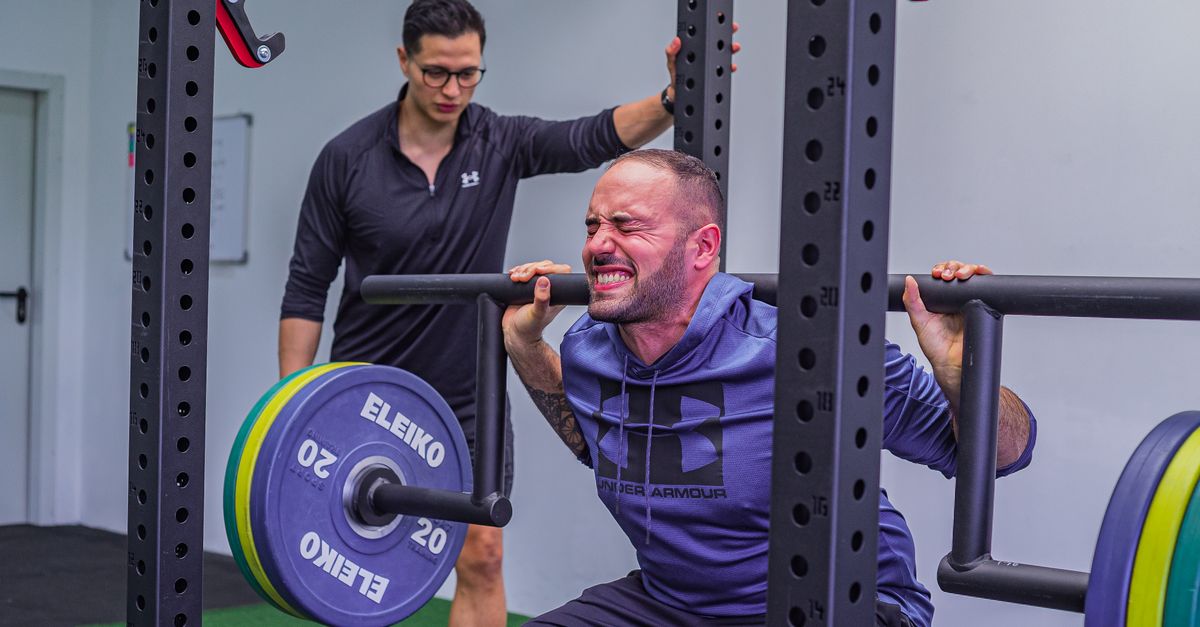
The squat is the foundation of lower-body strength. A box squat — squatting down to lightly tap a chair or bench and standing back up — is an excellent starting point because the box teaches depth and gives you a confidence target. Stand with feet shoulder-width apart, sit your hips back as if reaching for a chair, keep your chest up, and drive through your heels to stand. A slow squat, where you take three to four seconds to lower, adds time under tension without adding any weight.
2. Hinge (hamstrings, glutes, lower back)
The hip hinge trains the entire back of your body. A dumbbell Romanian deadlift is the most accessible version: holding a pair of dumbbells, push your hips straight back while keeping a soft bend in the knees and a flat back, lowering the weights along your shins until you feel a stretch in your hamstrings, then drive your hips forward to stand. A single-leg glute bridge is a no-equipment alternative that hammers the glutes.
3. Push (chest, shoulders, triceps)
Pressing movements preserve upper-body pushing muscles. A wide push-up is the simplest scalable option — elevate your hands on a counter or wall to make it easier, or do them from your knees. A dumbbell shoulder press, pressing weights overhead from shoulder height, covers the overhead pattern.
4. Pull (back, biceps)
Pulling is the most neglected pattern for home exercisers, and the back is a large muscle group worth protecting. A bent-over dumbbell row — hinging at the hips and pulling the weights toward your ribs — is the staple. We cover this pattern in depth in our guide to the best dumbbell back exercises. If you train with bands instead of dumbbells, our resistance band workout for weight loss has band-based pulling options.
5. Core / brace (abs, obliques)
A strong, braced midsection protects your spine during every other lift. The front plank — holding a straight line from head to heels on your forearms — is the most effective and the safest place to start. Begin with 20–30 seconds and build from there.
A simple weekly template
Here is a full-body, muscle-preserving week you can run with nothing but a pair of dumbbells and a sturdy chair. It satisfies the CDC's twice-weekly minimum with room to spare.
Monday — Full body A - Box squat — 3 sets of 10 - Bent-over dumbbell row — 3 sets of 10 - Wide push-up — 3 sets of 8–12 - Front plank — 3 sets of 30 seconds
Wednesday — Rest or light walking
Thursday — Full body B - Dumbbell Romanian deadlift — 3 sets of 10 - Dumbbell shoulder press — 3 sets of 10 - Single-leg glute bridge — 3 sets of 10 per side - Front plank — 3 sets of 30 seconds
Saturday — Full body A again (or repeat whichever you have energy for)
Rest 60–90 seconds between sets. Choose a weight where the last two reps of each set feel genuinely challenging. As you get stronger, add a little weight or one more rep — this gradual increase, called progressive overload, is what keeps the muscle-preservation signal strong.
If you want a more structured progression, our strength training for weight loss guide goes deeper on sets, reps, and how to advance.
Training around GLP-1 side effects
Medication side effects can make training feel different, especially in the first weeks or after a dose change. None of the following is medical advice — if a symptom is severe or persistent, talk to your prescriber — but these are sensible, conservative adjustments many people find helpful:
- Nausea or low appetite: Train earlier in the day if mornings feel better, keep sessions short (20–30 minutes), and don't force a big pre-workout meal. The goal during a rough week is to maintain the habit, not to set records.
- Fatigue: Reduce the number of sets rather than skipping the session entirely. Two hard sets done consistently beats four sets you keep avoiding.
- Dehydration: GLP-1 medications can reduce how much you eat and drink. Sip water before and during training.
Consistency through the ups and downs is what preserves muscle. A lighter session you actually do is infinitely better than a perfect session you skip.
How long until you see results
Muscle preservation is partly invisible — its biggest benefit is the muscle you *don't* lose, which never shows up as a dramatic before-and-after photo. That said, most people training consistently notice meaningful strength gains within four to six weeks, and clearer body composition changes (firmer, more defined look at the same or lower weight) within two to three months.
The scale may move more slowly than it would with diet alone, because you are holding onto dense, calorie-burning muscle. That is exactly what you want. As MedlinePlus notes, regular strength activity improves not just appearance but balance, bone density, and day-to-day function — benefits that compound for the rest of your life, long after you reach your goal weight.
The bottom line
Weight-loss medication is a powerful tool for removing fat. Resistance training is the tool that decides what kind of body you are left with when the fat is gone. Train each major muscle group at least twice a week, prioritize protein, build your sessions around compound movements, and adjust — don't abandon — your routine when side effects flare.
Do that, and the weight you lose will be fat. The strength, shape, and metabolism you keep will be yours.
*This article is educational and not a substitute for personalized medical advice. Always consult your prescriber before starting a new exercise program, especially while taking weight-loss medication.*