Introduction
HIIT is one of the most time-efficient ways to burn fat. Here are three 20-minute HIIT workout routines for weight loss, plus the science behind why they work.
High-Intensity Interval Training (HIIT) is one of the most time-efficient ways to burn fat. A typical HIIT workout takes 15–25 minutes but produces metabolic effects that last for hours after you finish.
A 2016 study in Obesity Reviews analyzed 28 studies and found that HIIT reduced body fat significantly more than steady-state cardio — even when the HIIT sessions were shorter. The key advantage is what researchers call the afterburn effect: your metabolism stays elevated for up to 24 hours after a HIIT session, burning additional calories while you rest.
Table of Contents
- How HIIT works
- HIIT Workout 1: Bodyweight Only (no equipment)
- HIIT Workout 2: Treadmill or Outdoor Running
- HIIT Workout 3: Kettlebell or Dumbbell Circuit
- How to fit HIIT into your weekly routine
- Important precautions
- Why HIIT works with strength training
How HIIT works
HIIT alternates short bursts of intense effort with brief recovery periods. The pattern looks like this:
Work interval: 20–40 seconds at 80–95% of your maximum effort Rest interval: 10–60 seconds of very light activity or complete rest Repeat: 6–12 rounds, totaling 15–25 minutes
The intensity is what distinguishes HIIT from regular cardio. You should be breathing hard enough that carrying on a conversation is difficult.
HIIT Workout 1: Bodyweight Only (no equipment)
Format: 30 seconds work / 15 seconds rest / repeat each exercise 3 times
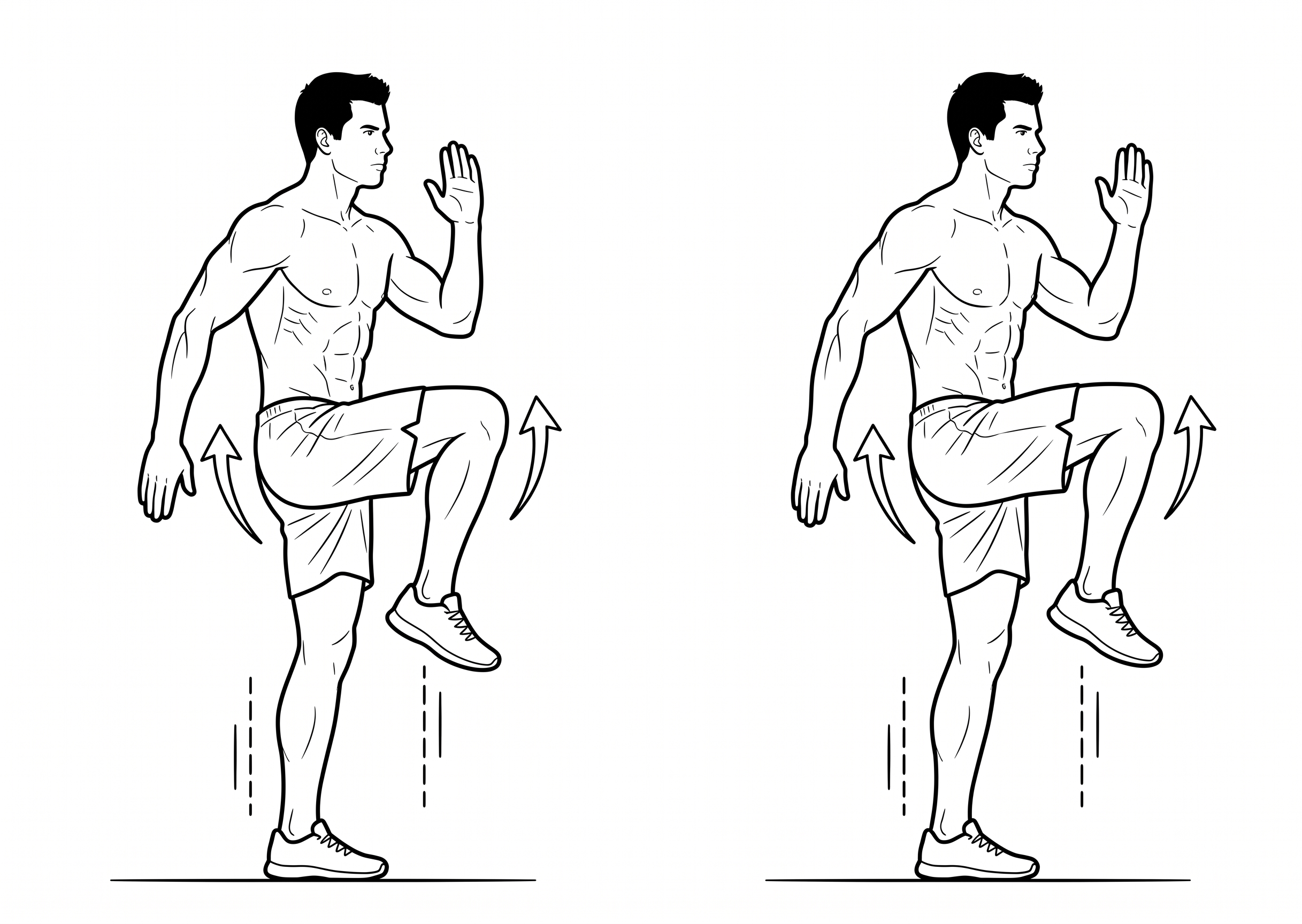
- High knees — Run in place, driving your knees up as high as possible
- Burpees — From standing, drop to a push-up position, jump your feet back in, explode up
- Mountain climbers — Plank position, drive knees to chest as fast as possible
- Jump squats — Squat down, explode up into a jump
- Plank jacks — Plank position, jump feet out and in like a jumping jack
- Rest — 60 seconds after completing all 5 exercises
- Repeat the full circuit — 2–3 total rounds
Total time: 18–24 minutes
HIIT Workout 2: Treadmill or Outdoor Running
Format: 30 seconds sprint / 60 seconds jog or walk / repeat 8 times
- Warm-up: 3 minutes of light jogging
- Interval 1: Sprint at 80–90% effort for 30 seconds
- Recovery 1: Jog or brisk walk for 60 seconds
- Repeat intervals 2–8: Complete all 8 sprint intervals
- Cool-down: 3 minutes of walking
Total time: 16 minutes
This is known as the 30/60 HIIT protocol. It's one of the most studied HIIT formats and has been shown to improve VO2 max and insulin sensitivity in addition to burning fat.
HIIT Workout 3: Kettlebell or Dumbbell Circuit
Format: 40 seconds work / 20 seconds rest / 5 exercises / 2 rounds
- Kettlebell swings — 40 seconds (use a weight you can swing with control)
- Dumbbell thrusters (squat to overhead press) — 40 seconds
- Battle ropes or jumping rope — 40 seconds
- Dumbbell clean and press — 40 seconds per side
- Rest — 60 seconds after all 4 exercises
- Repeat all 4 exercises once more
Total time: 15 minutes
How to fit HIIT into your weekly routine
HIIT is effective but demanding. Your central nervous system needs recovery just like your muscles do. Limit HIIT to 2–3 sessions per week with at least 48 hours between sessions.
The ideal weekly split for weight loss combines HIIT with Strength Training for Weight Loss:
| Day | Workout |
|---|---|
| Monday | Strength training (full body) |
| Tuesday | HIIT (15–20 min) |
| Wednesday | Rest or light walking |
| Thursday | Strength training (full body) |
| Friday | HIIT (15–20 min) |
| Saturday | Walking or light cycling |
| Sunday | Rest |
Important precautions
HIIT is safe for most healthy adults, but it places significant stress on your cardiovascular system and joints:
- If you've been sedentary, start with brisk walking for 2–4 weeks before attempting HIIT
- Listen to your knees and lower back — modify jumping exercises to low-impact alternatives if needed
- The Mayo Clinic recommends starting with one HIIT session per week and gradually building up
- Stop immediately if you experience chest pain, dizziness, or joint pain
Why HIIT works with strength training
Strength training preserves muscle during weight loss. HIIT burns additional calories and improves cardiovascular fitness. Together, they're the most effective exercise combination for changing your body composition.
For a full understanding of how exercise supports weight loss, start with our Strength Training for Weight Loss guide.
FAQ
Is HIIT safe for beginners?
Yes, if you start at an appropriate intensity. Beginner HIIT means working at a 7 out of 10 effort during work intervals, not an all-out sprint. Start with shorter work intervals (20 seconds) and longer rest periods (40 seconds). Listen to your body — sharp pain means stop, but being out of breath is normal. If you have joint issues, choose low-impact options like cycling, swimming, or incline walking instead of running or jumping.
How many times per week should I do HIIT?
Two to three sessions per week is the recommended range. HIIT places significant stress on your central nervous system and muscles, so your body needs 48 hours between sessions to recover. Doing HIIT more than four times per week increases injury risk without providing additional fat loss benefits. On the other days, include low-intensity activity like walking or gentle cycling.
Do I need to do HIIT on an empty stomach for fat burning?
No. The idea that fasted cardio burns more fat has been largely debunked. While your body does use a higher percentage of fat for fuel during fasted exercise, the total fat loss over 24 hours is the same whether you eat beforehand or not. What matters is your total calorie deficit across the day, not whether you ate before your workout.
How long until I see results from HIIT?
Most people notice improved cardiovascular endurance within two to three weeks. Visible changes in body composition typically take six to eight weeks with consistent training and a proper diet. The scale may not move dramatically because HIIT can build muscle while burning fat, but you'll likely notice that your clothes fit differently and your energy levels are higher throughout the day.